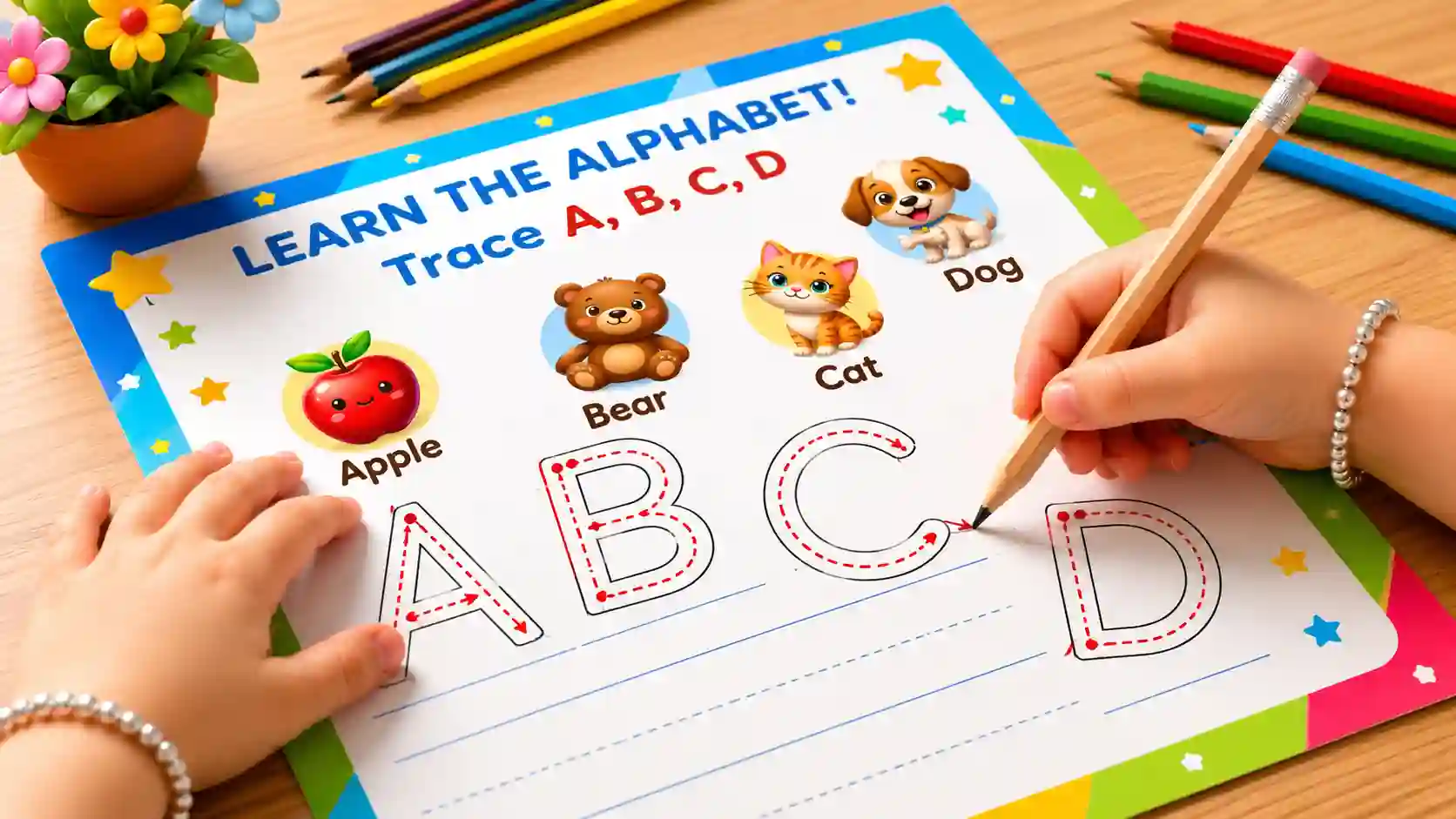
Why Printable Worksheets Matter for Early Learning | VidyaFrame

In an increasingly digital era, educational technology platforms frequently advocate for screen-first learning. Touchscreen tablets, interactive apps, and digital quizzes have swept through primary classrooms. However, a growing, definitive body of research across cognitive neuroscience, developmental psychology, and pediatric occupational therapy points to a clear conclusion: physical, paper-based printable worksheets remain an irreplaceable foundation for early brain development (Ages 3 to 8 / Nursery to Class 3).
While digital screens offer convenience, they fail to replicate the complex visual, tactile, and kinesthetic feedback loops that occur when a child holds a physical pencil and moves it across paper. In this research-backed master guide, we explore why printable worksheets vs digital screen learning matters so deeply for your child's neurodevelopment.
1. Hand-Brain Neural Connection & Haptic Learning
When a child writes on paper, they are not merely completing an exercise — they are actively wiring their brain for literacy. Cognitive neuroscientists refer to this as embodied cognition: the principle that thinking and learning are deeply rooted in physical, sensory-motor experiences.
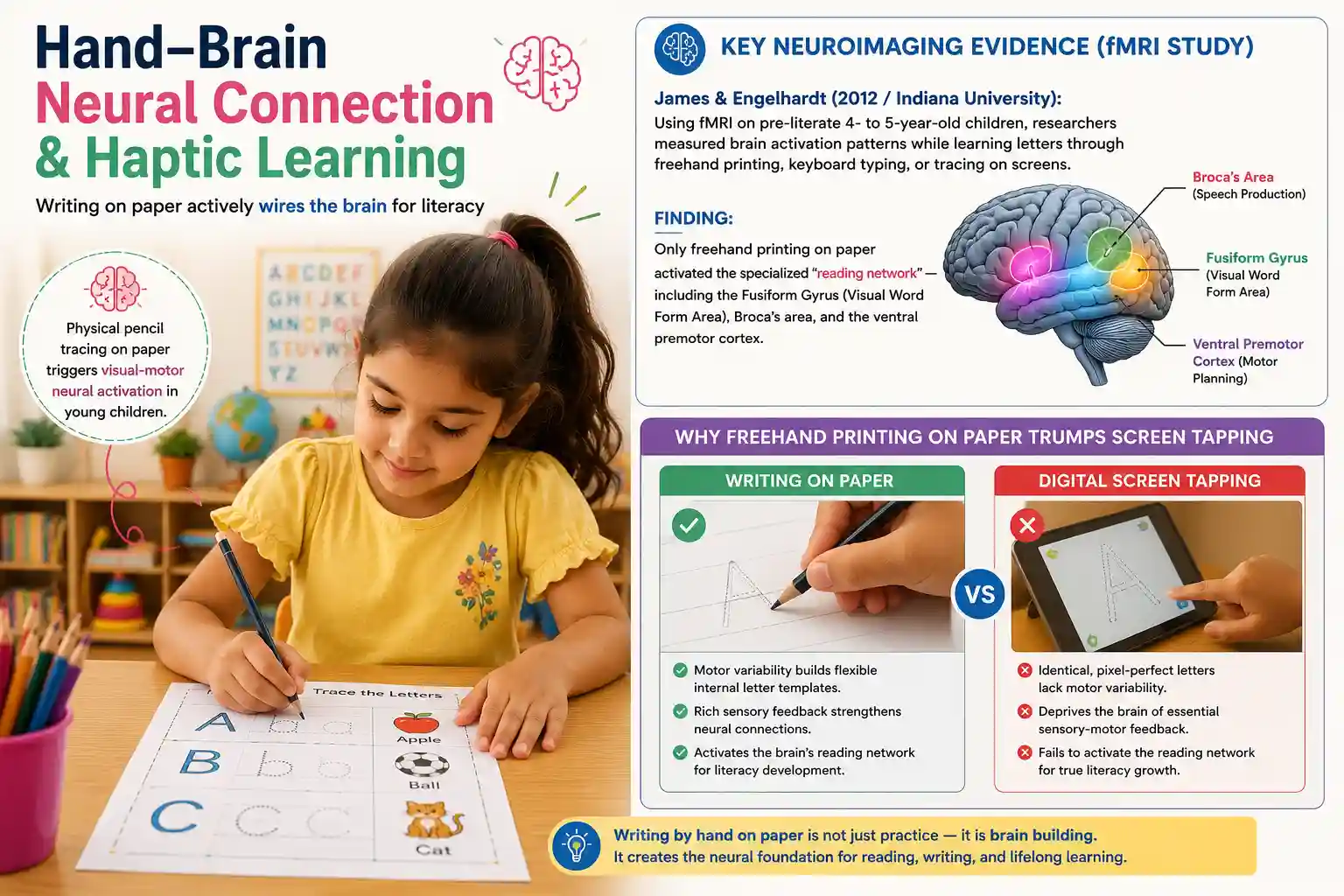
Physical pencil tracing on paper triggers visual-motor neural activation in young children.
🧠 Key Neuroimaging Evidence (fMRI Study):
James & Engelhardt (2012 / Indiana University): Using functional MRI on pre-literate 4- to 5-year-old children, researchers measured brain activation patterns while learning letters through freehand printing, keyboard typing, or tracing on screens.
Finding: Only freehand printing on paper activated the specialized "reading network" — including the Fusiform Gyrus (Visual Word Form Area), Broca's area, and the ventral premotor cortex. Typing or tracing on flat glass failed to produce this neural recruitment.
Why Freehand Printing on Paper Trumps Screen Tapping
On a digital device, pressing a key or tapping a button produces an identical, pixel-perfect letter. The hand performs the exact same mechanical motion for "A" as it does for "Z". Consequently, the brain is deprived of the motor-sensory feedback required to build robust neural representations. On paper, motor variability forces the brain to construct a flexible, generalized internal template of each letter (Kersey & James, 2013; Marano et al., 2025).
2. Fine Motor Control & Pincer Grip Development
Before a child can master fluent handwriting or drawing, they must build intrinsic hand muscle strength and fine motor precision.
Pediatric Occupational Therapy Evidence:
- Dynamic Tripod Pincer Grip: Tracing dashed lines, navigating mazes, and coloring on paper strengthens thumb, index, and middle finger muscles (NAPA Center OT Research, 2025).
- Proprioceptive Resistance: Paper provides natural friction against graphite pencils, teaching the nervous system how to calibrate writing force.
- Midline Crossing: Physical worksheets require dominant hands to cross body midlines and track visual lines from left to right (Feder & Majnemer, 2007).
3. Dual Coding Theory & Visual-Spatial Memory
Why do children remember information better when they write it on a printable worksheet? Allan Paivio's Dual-Coding Theory (1971, 1986) explains that human memory operates through two interconnected systems: the Verbal System and the Non-Verbal/Visual-Kinesthetic System.
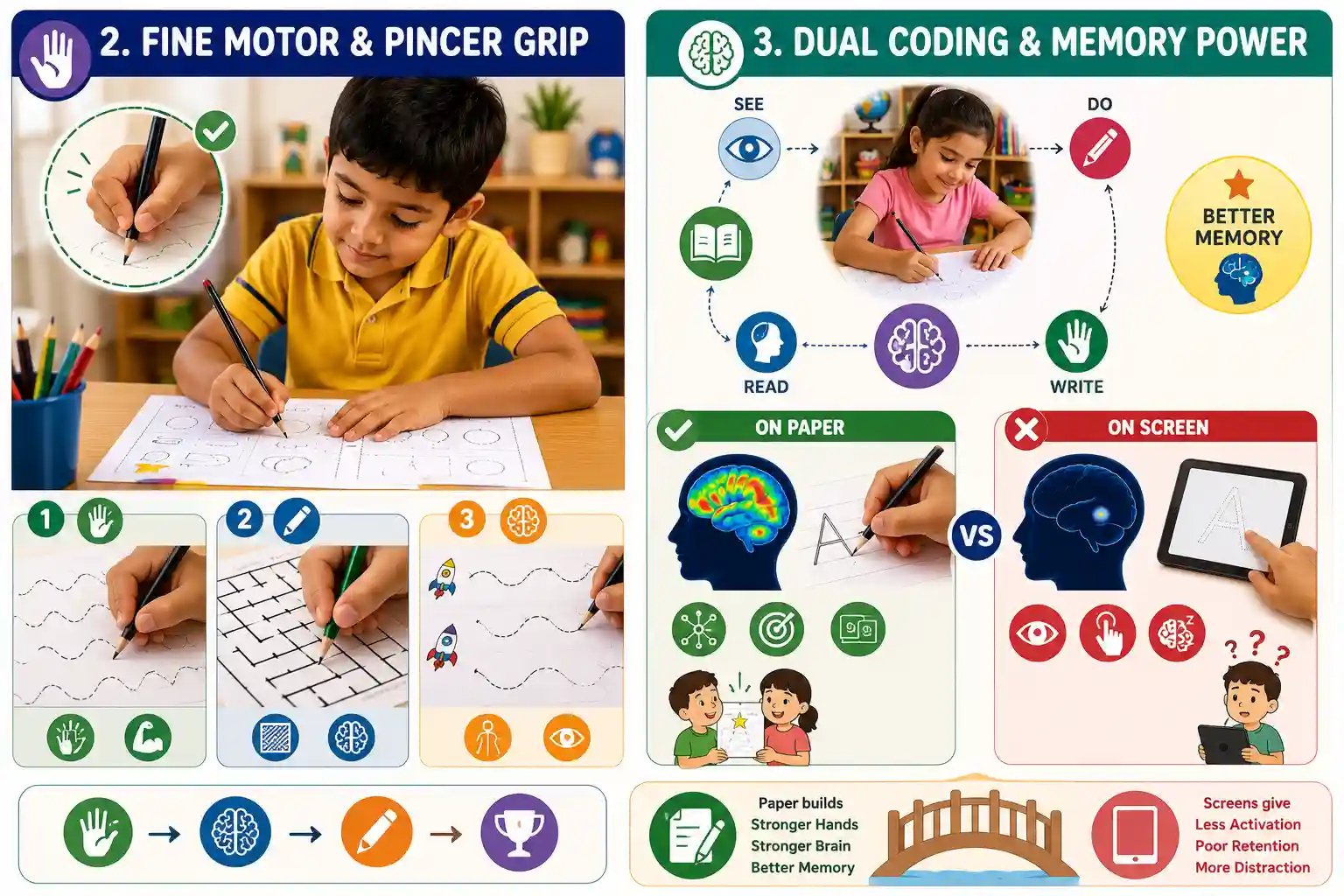
Paper worksheets create triple encoding (verbal + visual + haptic motor memory).
When completing a printable worksheet, children engage triple encoding: reading the word (verbal code), seeing the visual diagram (visual code), and physically guiding their pencil (haptic motor code). High-density EEG research by Prof. Audrey van der Meer (2024, NTNU) revealed that handwriting on physical paper triggers widespread theta and alpha brainwave connectivity, boosting spatial memory recall by 25–30% over borderless digital screens.
4. Digital Screen Fatigue vs. Tactile Focus (Screen-Free Learning)
Digital touchscreens emit high-energy blue light and rapid refresh rates that strain young eyes. Furthermore, interactive digital apps often cause over-arousal through hyper-stimulating animations and sound effects, promoting impulsive tapping over deliberate thinking (Frontiers in Psychology, 2026; Hutton et al., 2019).
🏥 Health Organization Screen Guidelines:
Both the American Academy of Pediatrics (AAP, 2026) and the World Health Organization (WHO, 2019) mandate restricting digital screen time for young children (ages 2–5) to under 1 hour daily, emphasizing screen-free, physical, tactile learning materials to foster healthy cognitive growth.
5. Cognitive Load Theory & Deep Concentration
According to John Sweller's Cognitive Load Theory (1988), working memory in young children has limited capacity. Digital learning apps create high extraneous load through pop-ups, back-buttons, ads, and touch sensitivity errors.
A printable paper worksheet features zero interface friction. The child's entire working memory bandwidth is dedicated to solving the task at hand, helping them achieve sustained attention and a deep state of concentration — known as Flow State (Csikszentmihalyi, 1990).
6. Parent-Child & Teacher-Student Connection (The Paper Bridge)
Learning is a social and emotional process. A completed paper worksheet serves as a physical communication bridge between classroom and home.
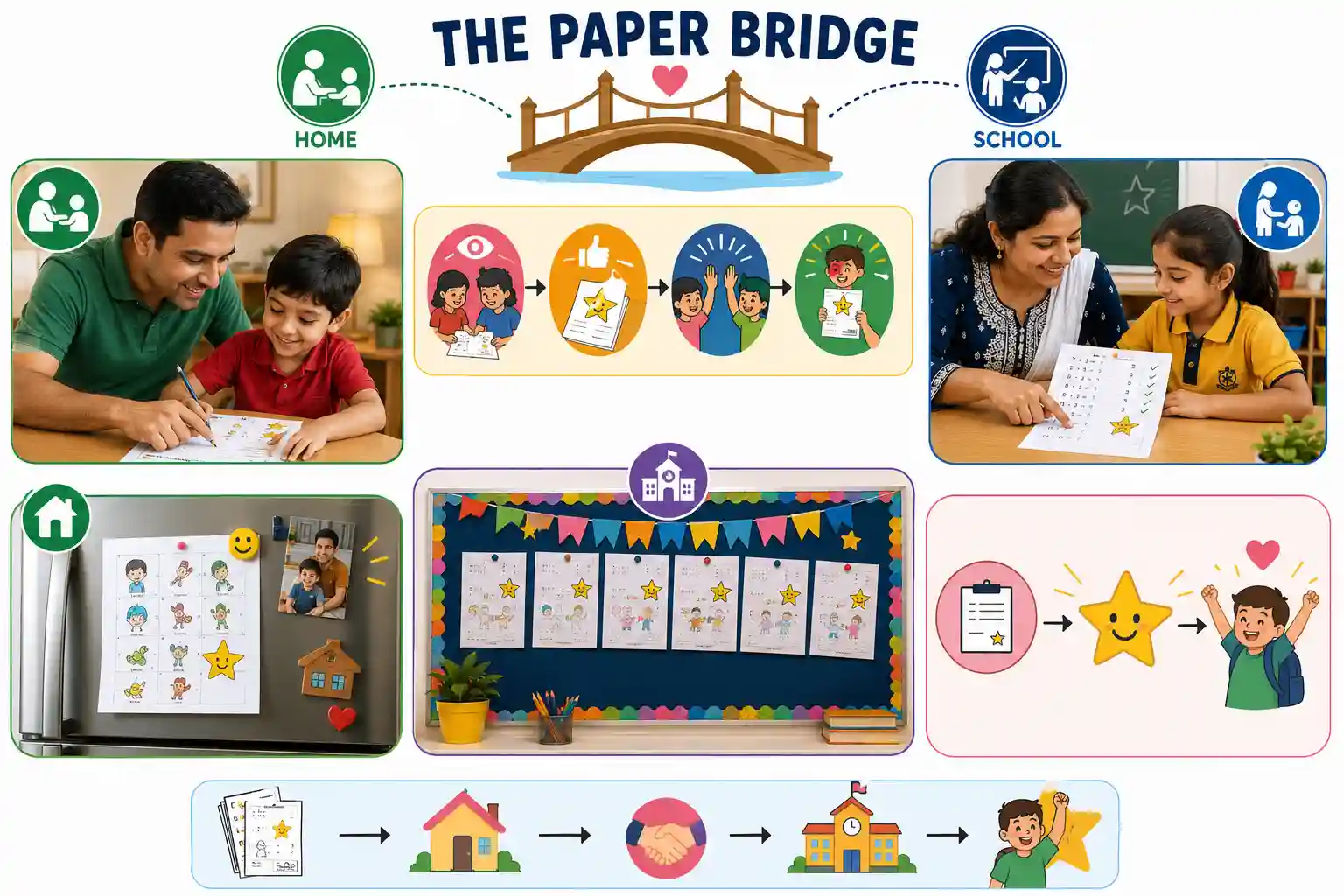
Physical worksheets enable joint attention, tangible feedback, and parental encouragement.
- Joint Attention (Tomasello, 1995): Adults and children share synchronized focus on a flat paper sheet placed between them, unlike private digital screens.
- The Refrigerator Effect (Bandura, 1977): Displaying a child's star-marked worksheet on a home refrigerator or classroom bulletin board builds self-efficacy and intrinsic pride.
7. Science Summary Comparison Table
Comparing physical paper worksheets against digital touchscreens across key cognitive metrics:
| Cognitive Metric | Physical Paper Worksheets | Digital Touchscreens | Scientific Source |
|---|---|---|---|
| Reading Network Activation | High activation in Fusiform Gyrus & Broca's Area | Minimal reading network activation | Dr. Karin James, Indiana Univ (2012) |
| Fine Motor & Grip | Builds intrinsic hand muscles & tripod grip | Flat glass tapping/swiping; zero motor strength | NAPA Center OT Research (2025) |
| Spatial & Long-Term Memory | Superior recall through physical spatial landmarks | Shallow processing; borderless screen distraction | van der Meer & van der Weel (2024) |
| Cognitive Load | Low extraneous load; fosters deep Flow State | High extraneous load from ads & pop-ups | John Sweller (1988) |
| Health & Fatigue | Tactile calm; zero light emission or eye strain | Visual fatigue; blue light emission & over-arousal | AAP (2026) / WHO (2019) |
8. Best Practices for Teachers & Parents
- 1. Quality Over Quantity (10–15 Min Rule): Keep worksheet sessions short, targeted, and high-impact.
- 2. Use CPA Sequence (Bruner): Pair worksheets with physical counting blocks or playdough before moving to abstract symbols.
- 3. Allow Motor Variability: Let children form letters naturally; don't force rigid robot-like tracing.
- 4. Balance with Gross Motor Play: For every 15 minutes of paper worksheet practice, provide 30 minutes of physical play.
Frequently Asked Questions (FAQs)
Q1. Are digital tracing apps completely useless for children?
A: Digital apps can offer novelty and quick games, but neuroimaging studies confirm they do not activate the brain's reading network or build fine motor muscles like physical pencil-and-paper writing does.
Q2. What age should children start using printable worksheets?
A: Basic coloring and tracing worksheets can start around age 3 (Nursery). Formal letter writing and number practice begin around age 4 to 5 (LKG/UKG).
Q3. Where can I find research-aligned free printable worksheets?
A: You can explore VidyaFrame's complete library of Free Printable Worksheets and Educational Charts for Nursery through Class 5.
Conclusion
Digital technology has its place, but science proves it cannot replace physical paper worksheets for early childhood brain development. By engaging the hand-brain neural network, building pincer grip strength, reducing cognitive load, and fostering family connections, printable worksheets remain a vital, scientifically backed foundation for learning.
Build Strong Learning Foundations Today
Download high-quality, research-backed printable worksheets and charts tailored for Nursery to Class 5 on VidyaFrame.

Written by Kanhaiya Lal
View Website & Portfolio →VidyaFrame Founder & Teacher
Educator & Founder of VidyaFrame. Designing interactive educational charts, worksheets, and learning resources for primary students, teachers, and parents.
Enhance your learning
Download beautifully designed worksheets and educational charts related to this topic for free.